Search This Blog

Thursday, May 2, 2019

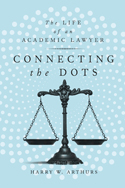
Just published: Connecting the Dots: the Life of an Academic Lawyer by Harry W. Arthurs


Just published (by McGill-Queen's University Press) Harry W. Arthurs memoir, Connecting the Dots: the Life of an Academic Lawyer. This is the Osgoode Society Members' book for this year.
Here's the publishers' blurb:
Connecting the DotsHarry W. Arthurs is a name held in high esteem by labour lawyers and academics throughout the world. Although many are familiar with Arthurs's contributions and accomplishments, few are acquainted with the man himself, or how he came to be one of the most influential figures in Canadian law and legal education. 

In Connecting the Dots Arthurs recounts his adventures in academe and the people, principles, ideas, motivations, and circumstances that have shaped his thinking and his career. The memoir offers intimate recollections and observations, beginning with the celebrated ancestors who influenced Arthurs's upbringing and education. It then sweeps through his career as an architect of important reforms in legal education and explores his research as a trailblazing commentator on the legal profession. Arthurs analyzes his experiences as a legal theorist and historian and his pivotal role as a discordant voice in debates over constitutional and administrative law. Along the way, he muses on the intellectual projects he embraced or set in motion, the institutional reforms he advocated, the public policies he recommended, and how they fared long term.

Framed with commentary on the historical context that shaped each decade of his career and punctuated by moments of personal reflection, Connecting the Dots is a humorous, frank, and fearless account of the rise and fall of Canadian labour law from the man who was at the centre of it all.

Sunday, April 7, 2019

Available for pre-order: Nichols, A Reconciliation without Recollection?: An Investigation of the Foundations of Aboriginal Law in Canada

Available for pre-order from U of T press: A Reconciliation without Recollection?: An Investigation of the Foundations of Aboriginal Law in Canada by Joshua Ben David Nichols

The current framework for reconciliation between Indigenous peoples and the Canadian state is based on the Supreme Court of Canada’s acceptance of the Crown’s assertion of sovereignty, legislative power, and underlying title. The basis of this assertion is a long-standing interpretation of Section 91(24) of Canada’s Constitution, which reads it as a plenary grant of power over Indigenous communities and their lands, leading the courts to simply bypass the question of the inherent right of self-government.
In A Reconciliation without Recollection, Joshua Ben David Nichols argues that if we are to find a meaningful path toward reconciliation, we will need to address the history of sovereignty without assuming its foundations. Exposing the limitations of the current model, Nichols carefully examines the lines of descent and association that underlie the legal conceptualization of the Aboriginal right to govern.
Blending legal analysis with insights drawn from political theory and philosophy, A Reconciliation without Recollection is an ambitious and timely intervention into one of the most pressing concerns in Canada.

CFP: CLSA Mid-Year Meeting / AÀC: La rencontre de mi-année de l’ACDS

From the ACDS/CLSA:

(good idea moving the date imo)

CLSA Mid-Winter Meeting is moving to the Fall!

La rencontre de mi-hiver de l’ACDS sera à l’automne!

[English follows]

Chers membres,

L’Association Canadienne Droit et Société (ACDS) vous invite à soumettre vos contributions pour sa prochaine rencontre de mi-année qui aura lieu à la faculté de droit de l’Université d’Ottawa, Ottawa (ON), située sur les territoires ancestraux non cédés de la nation algonquine (Anishinàbeg), les 18 et 19 octobre 2019.

La conférence de mi-année est une rencontre plus petite et informelle que les conférences annuelles. C’est l’occasion parfaite pour la discussion des projets en cours, rencontrer d’autres membres pancanadiens de l’ACDS et vous impliquer dans l’organisation.

Cette année, le thème de la conférence s’intitule « Le droit et le savoir à l’ère des partenariats ».

 En 1979, seulement deux subventions de recherche du CRSH ont été accordées aux chercheurs en droit. Cela a conduit à la création du Groupe consultatif sur la recherche et l’éducation en droit et à la publication du rapport Le droit et le savoir de Harry Arthurs. Quarante ans après le sombre scénario de 1979, les chercheurs en droit ont aujourd'hui une grande participation au principal programme de financement du CRSH (Subventions de partenariat), en tant que chercheurs ou directeurs de projet. Nous souhaitons discuter de l’état de la recherche sociojuridique dans le contexte actuel de ces grands projets à long terme, interdisciplinaires et collaboratifs.

Les membres sont encouragés à organiser des tables-ronde ou des panels s’articulant autour des grands thèmes de la recherche sociojuridique, dont « les projets en partenariat », « le droit et l’interdisciplinarité », « les perspectives juridiques autochtones », « le droit et l’engagement communautaire » ou tout autre thème ayant trait aux études sociojuridiques et ses méthodologies.

Prière d’envoyer une petite bio et un bref extrait ou description de votre table ronde, de votre suggestion de panel ou de votre contribution personnelle (250 mots maximum) à joao.velloso@uottawa.ca avant le 28 avril 2019.

Les contributions retenues seront présentées le vendredi 18 octobre et le matin du samedi 19 octobre 2019. La réunion du conseil d’administration aura lieu dans l’après-midi du samedi 19 octobre 2019.

Veuillez noter que les conférenciers doivent être membres de l’ACDS. L’inscription à la conférence est gratuite.

En espérant vous voir en grand nombre en octobre.

Dr. Joao Velloso, Comité organisateur et conseil d’administration de l’ACDS
Dr. Nicole O’Byrne, Présidente de l’ACDS
* * * * * * *
Dear Members,

This is a general call for participation in the CLSA’s annual mid-year meeting, which will take place at the Faculty of Law of the University Ottawa, Ottawa (ON), located on the ancestral unceded territory of the Algonquin Nation, on October 18-19, 2019.

The mid-year meeting is a relatively small, informal gathering when compared to the annual meetings, and is a great way to discuss ongoing projects, connect with CLSA members from across the country and get involved in the organization.

The broad theme for this year is “Law & Learning in an Era of Partnerships.”

In 1979, only two SSHRC research grants were awarded in law, leading to the creation of the Consultative Group on Research and Education in Law and to the publication of the Harry Arthurs’ Law & Learning report in 1983. Forty years after the dismal scenario of 1979, legal scholars today are major participants in one of SSHRC’s top funding programs (Partnership Grants), both as principal and co-investigators. This meeting will discuss the state of socio-legal research in the current context of such long term, interdisciplinary and collaborative projects.

Members are encouraged to organize roundtable discussions or panels around themes within socio-legal scholarship, including “Law and Partnership Projects”, “Law and Interdisciplinarity,” “Indigenous Legal Perspectives,” “Law and Community Engagement,” or any other topics that broadly fall in the area of socio-legal studies and methodologies. Individual submissions for paper presentations are also welcome.

Please send a brief abstract or description of your roundtable, panel or individual paper (up to 250 words) and a short bio to joao.velloso@uottawa.caby April 28, 2019.

All accepted presentations will be given on Friday, October 18 and the morning of Saturday, October 19, 2019. The board meeting will take place in the afternoon of Saturday, October 19, 2019.

Note that all presenters must be members of the CLSA at the time of the conference. Registration for the conference is free.

We hope to see you in Ottawa in October.

Dr. Joao Velloso, Local Organizing Committee and CLSA Board Member
Dr. Nicole O’Byrne, President of the CLSA

Friday, April 5, 2019

In memoriam--W. Wesley Pue

The Canadian legal history community has lost one of its leading lights. W. Wesley (Wes) Pue died on Wednesday April 3rd, after a long illness. Wes was one of Canada’s leading legal historians, and taught at Osgoode Hall, Carleton, Manitoba and the University of British Columbia. At the last-named he was the first Nemetz Professor of Legal History. Wes was best known for his work on the legal profession, some of which was published as chapters in Osgoode Society books, and much of which appeared in Lawyers Empire: Legal Professions and Cultural Authority, 1780-1850 (2016). Wes was also remarkable for the support and encouragement he gave to others, particularly students of legal history who went through UBC’s graduate programme in the area. He leaves behind a wonderful wife, Joanne, and two daughters, Heather and Colleen. A Memorial Service will be held on Thursday April 11th at 2:00 p.m. at St. David’s Anglican Church, 1115 - 51A Street, Delta, B.C., V4M 2Y2.  All are welcome.  Donations in support of Wes’ journey to Inspire Health or the B.C. Cancer Agency are much appreciated.

Thursday, April 4, 2019

Wes Pue


Sad news.

Many of you will have known Wes Pue, a Professor of Law at UBC, one of Canada’s leading legal historians for the last 30 years, and an all-round good guy who was always willing to encourage and help others.  We are sorry to report that Wes passed away on Wednesday, April 3rd, after a long illness. A fuller notice about Wes will be posted on the Osgoode Society website tomorrow.

Thursday, February 14, 2019

Kislowicz and Luk, 'Recontextualizing Ktunaxa Nation v. British Columbia: Crown Land, History and Indigenous Religious Freedom" on SSRN

Howard Kislowicz and Senwung Luk have posted "Recontextualizing Ktunaxa Nation v. British Columbia: Crown Land, History and Indigenous Religious Freedom" on SSRN. The article has been published in the Supreme Court Law Review.

Abstract: 

In Ktunaxa Nation v British Columbia (Forests, Lands and Natural Resource Operations), the Supreme Court of Canada addressed, for the first time, a religious freedom claim under the Charter based on Indigenous spiritual beliefs and practices. The Indigenous Ktunaxa Nation had opposed the development of a ski resort in the area of Qat’muk, also called Upper Jumbo Valley. They said Qat’muk is sacred because of its association with the Grizzly Bear Spirit and, should the proposed development be carried out, the Grizzly Bear Spirit would leave, destroying Qat’muk’s spiritual significance. The Court held that the Charter right of religious does not protect the “spiritual focal point of worship.” Because the Ktunaxa Nation was seeking to protect the Grizzly Bear Spirit itself, the Court reasoned, its claim fell outside the Charter’s ambit. 

We argue that this development could yield results inconsistent with the purposes of protecting religious freedom and is likely to have disproportionately onerous effects on Indigenous spiritual practices. We highlight these effects by presenting some of the historical context of land grants made by colonial powers to dominant religious groups allied with the settler state. To the extent that Ktunaxa suggests that religious groups should rely on property rights rather than religious freedom, the approach privileges dominant groups over non-Indigenous religious minorities because of historical grants made by the state, which also dispossessed Indigenous groups. We suggest that a more appropriate approach to reconciling religious freedom interests with the property interests of the Crown or third parties is to be found in the existing case law on the interaction of religious freedom and zoning regulations. Finally, we suggest that land selection processes under modern treaty negotiations present yet another way to avoid conflict

Monday, February 11, 2019

Peter Gonville Stein book award for non-U.S. legal history (in English)


Peter Gonville Stein book award: (via Matthew Mirow)
Note deadline of March 15th. No Canadian book has won yet--this may be our year!

CRITERIA

Best book in legal history (written in English) outside the field of US legal history, published during the previous calendar year.

AMOUNT

$500

DEADLINE

March 15, 2019
The Peter Gonville Stein Book Award is awarded annually for the best book in legal history written in English. This award is designed to recognize and encourage the further growth of fine work in legal history that focuses on all non-US regions, as well as global and international history. To be eligible, a book must sit outside of the field of US legal history and be published during the previous calendar year. Announced at the annual meeting of the ASLH, this honor includes a citation on the contributions of the work to the broader field of legal history. A book may only be considered for the Stein Award, the Reid Award, or the Cromwell Book Prize. It may not be nominated for more than one of these three prizes.
The Stein Award is named in memory of Peter Gonville Stein, BA, LLB (Cantab); PhD (Aberdeen); QC; FBA; Honorary Fellow, ASLH, and eminent scholar of Roman law at the University of Cambridge, and made possible by a generous contribution from an anonymous donor. Read more about Dr. Stein here.
For the 2019 prize, the Stein Award Committee will accept nominations of any book (not including textbooks, critical editions, and collections of essays) that bears a copyright date of 2018 as it appears on the printed version of the book. Translations into English may be nominated, provided they are published within two years of the publication date of the original version.
Nominations for the Stein Award (including self-nominations) should be submitted by March 15, 2019. Please send an e-mail to the Committee at steinaward@aslh.net and include: (1) a curriculum vitae of the author (including the author’s e-mail address); and (2) the name, mailing address, e-mail address, and phone number of the contact person at the press who will provide the committee with two copies of the book. This person will be contacted shortly after the deadline. (If a title is short-listed, four further copies will be requested from the publisher.)
Please contact the committee chair, Matthew Mirow, with any questions at mirowm@fiu.edu.

Committee Members

  • Jisoo Kim (2017), The George Washington University
  • Jessica Marglin (2017), University of Southern California
  • Matthew C. Mirow (2017), Florida International University
  • Daniel Lord Smail (2017), Harvard University
  • David V. Williams (2017), University of Auckland
  • Rachel Jean Baptiste (2018), University of California, Davis