Posted on SSRN, Newsletter of the Research Committee of the Sociology of Law (2019)
A personal appreciation of Wes Pue by David Sugarman of Lancaster University Law School
Abstract:
A personal appreciation of Wes Pue (1954-2019), a leading light of Canadian legal history, who is best known for his richly detailed, ground-breaking research which unravelled the ways in which lawyers and legal education shaped culture, cultural authority, identity, politics and the British empire in England and its Empire from the late eighteenth to the early twentieth century.

Welcome to the Canadian Legal History Blog!
Wednesday, September 25, 2019

Monday, September 16, 2019
Legal history evening for professionals (updated with accreditation info)
*This program contains 1 hour of EDI Professionalism Content*
|
|||||||||||||||||||||||
|


Thursday, August 15, 2019
Wednesday, August 14, 2019
Justice Sharpe qua historian interviewed regarding the Lazier Murder
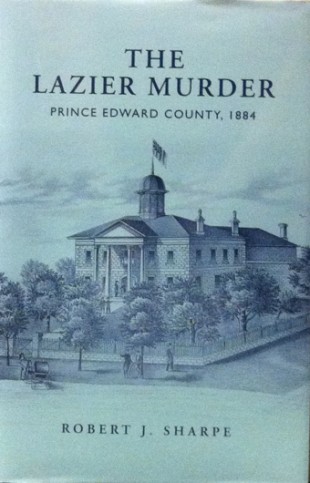 Fans of Justice Robert Sharpe's legal history work will be interested in this OBA interview with him about the Lazier Murder, a cause célèbre of late nineteenth century rural Ontario (h/t Amanda Campbell.)
https://www.listennotes.com/podcasts/oba-presents-holiday-hours-a-new-cpd-ucrNdLx3voS/
If the interviews spark your interest in Justice Sharpe's book on the case, take a look at the entry on the Osgoode Society website.
Robert Sharpe is one of the Osgoode Society’s most prolific authors, and his latest offering is a compelling account of a late nineteenth century murder case in Picton, Ontario. This very thoroughly researched and engagingly written case study details the murder of a local resident and the subsequent court and governmental proceedings. What emerges is a fascinating insight into the operation of the policing, prosecution and trial processes of late nineteenth century Ontario, one that shows how much public opinion and courtroom atmosphere could at times affect the outcome of a trial. The Lazier Murder also looks at the executive commutation process by which it was decided if those sentenced to be executed would be hanged. Sharpe’s account suggests that this may well have been a case of what we would now call a ‘wrongful conviction.’
Sunday, August 11, 2019
*Updated* Osgoode Society Legal History Workshop fall 2019
*Revised 10 August 2019*
OSGOODE SOCIETY LEGAL HISTORY WORKSHOP, 2019-2020:
FALL TERM 2019
Wednesday September 11: Nancy Wright, University of Victoria: “The Laphroaig
Leasehold: Popular Interpretations of Feudal Tenures.”
Wednesday September 25: Jim Phillips, University of Toronto: ‘The Canadian
Court System, 1867-1914’
Wednesday October 9 – Yom Kippur
Tuesday October 15: Note the Tuesday. Donal Coffey, Max Planck Institute:
‘Newfoundland and Dominion Status.’
Wednesday October 30 (new date): Philip Girard, Osgoode Hall Law School: ‘The
Contrasting Fates of French-Canadian and Indigenous Constitutionalism: British
North America, 1763-1867.’
Wednesday November 6: Eric Adams, University of Alberta: ‘Constitutional
Wrongs: A Legal History of Japanese Canadians’
Wednesday November 13 (new date): Joseph Kary, Kary and Kwan: Sonderkommando in
Canada: Montreal's first World War II War Crimes Trial, 1951-1956
Wednesday November 27: Patricia McMahon, Torys: ‘Radioactive: The Life and
Lies of Boris Pregel’
Friday, August 9, 2019
Osgoode Society Legal History Workshop--Fall 2019 Schedule
OSGOODE SOCIETY LEGAL HISTORY WORKSHOP, 2019-2020:
FALL TERM 2019
Starting is 6.30 as usual at U of T Law School, room to be announced.
If you would like to be put on the list for announcements and to receive copies of the papers to be presented, please email j.phillips@utoronto.ca
Wednesday September 11: Nancy Wright, University of Victoria: 'The Laphroaig
Leasehold: Popular Interpretations of Feudal Tenures'
Wednesday September 25: Jim Phillips, University of Toronto: ‘The Canadian
Court System, 1867-1914’
Wednesday October 9 – Yom Kippur, no session
Tuesday October 15: (Note that it's Tuesday, not Wednesday) Donal Coffey, Max Planck Institute:
‘Newfoundland and Dominion Status.’
Wednesday October 30: Joseph Kary, Kary and Kwan: 'Sonderkommando in
Canada: Montreal's first World War II War Crimes Trial, 1951-1956'
Wednesday November 6: Eric Adams, University of Alberta: ‘Constitutional
Wrongs: A Legal History of Japanese Canadians’
Wednesday November 13: Philip Girard, Osgoode Hall Law School: ‘The
Contrasting Fates of French-Canadian and Indigenous Constitutionalism: British
North America, 1763-1867’
Wednesday November 27: Patricia McMahon, Torys: ‘Radioactive: The Life and
Lies of Boris Pregel’
Tuesday, July 23, 2019
Torrie, "Farm Debt Compromises During the Great Depression: An Empirical Study of Applications made under the Farmers’ Creditors Arrangement Act in Morden and Brandon, Manitoba" on SSRN
Virginia Torrie of the University of Manitoba Law School has posted "Farm Debt Compromises During the Great Depression: An Empirical Study of Applications made under the Farmers’ Creditors Arrangement Act in Morden and Brandon, Manitoba" on SSRN. The article also appears in volume 41, issue 1 (2018) of the Manitoba Law Journal. [This journal is open access.]
This article presents the results of an empirical study of the Farmers’ Creditors Arrangement Act (FCAA) in Morden and Brandon, Manitoba. Parliament enacted this federal insolvency statute to address the agricultural crisis of the 1930s colloquially known as the “Dust Bowl”. The express purpose of the Act was to “keep the farmer on the farm” by reducing debts to an amount that the farmer could afford to pay. This is the first article to engage in a substantive analysis of the FCAA, and it employs a novel methodology for studying farm debt compromises under the Act. This study uncovers notable differences in the way that FCAA applications played out in Morden and Brandon. It reveals that much farm credit was obtained locally, with roughly half of all claims being owed to individuals or estates, which in many instances were the mortgage lender. In addition, medical debts listed the FCAA files call attention to the privation of the “Dirty Thirties” and the financial costs born by individuals for medical care in the pre-public health care era. The empirical findings of this study thus add to historical scholarship about the experience of the Great Depression on the Canadian Prairies by shedding light on the social context of debtor-creditor relations in farming communities, and highlighting regional variations in the application of a federal law designed to help address the farm debt crisis.
Subscribe to:
Posts (Atom)